
Victoria St. Safety-Led Revival Strategies
Purpose
To document how Victoria Street has shifted from managed decline toward stabilisation and early recovery through coordinated state and council action, targeted public investment, and clear leadership — and to position the corridor as a scalable model for other inner-Melbourne shopping strips.
Executive Summary
Victoria Street demonstrates that inner-city strip decline is not inevitable. Where the State and Council act in concert — restoring safety, aligning planning and transport settings, and visibly investing in place — suppressed demand returns.
The Victoria Street Strategy has succeeded not because of a single intervention, but because it treated safety, activation, planning, and governance as one integrated system, with clear roles across government. This briefing outlines what was done, why it mattered, and what lessons should now be applied elsewhere.
Context: Why Victoria Street Mattered
For more than a decade, Victoria Street was characterised by:
Persistent public safety concerns
Reduced pedestrian confidence, particularly after dark
High vacancy and low-quality activation
Fragmented agency responses across State and Local Government
Despite strong location fundamentals and cultural significance, the corridor failed to convert passing movement into sustained local economic activity.
The Strategic Shift: From Fragmentation to Place-Based Leadership
The turning point for Victoria Street was the decision to treat safety as economic infrastructure, requiring coordinated delivery across State and Council — not as a stand-alone social services response.
This reframing enabled Victoria Police, transport agencies, planning authorities, and Council to operate under a single place-based strategy, replacing ad hoc interventions with aligned action.
Pillar 1: Safety as the Precondition (State-Led, Locally Delivered)
The first and most critical intervention was restoring baseline safety and visibility.
Key actions:
Sustained Victoria Police and Protective Services Officer presence, including Police HQ–coordinated trials with targeted, intelligence-led deployment aligned to known risk times and locations
Expansion of CCTV coverage and significant public lighting upgrades delivered in partnership with Council
Clear and consistent enforcement of behavioural standards in public space
Outcomes:
Pedestrian confidence returned
Improved confidence in evening and night-time trading
Night-time trade became viable
Businesses could reliably staff evening hours
Improved perception among residents, visitors, and traders
Without this State-led safety reset, no amount of activation or capital investment would have held.
Pillar 2: Investment & Physical Reset (State Settings, Council Delivery)
Safety intervention was paired with visible, structural investment to reset how the street functions and is perceived.
Key actions:
Planning reform through revised commercial heights and setbacks and a Special Development Overlay (DDO) to unlock better built outcomes
Feasibility work to enable larger-format retail floor plates within heritage constraints
Support for feasibility studies combining housing delivery with viable commercial floor space
Congestion Levy relief for recovering strips to remove barriers to short-stay visitation
Proposed State acquisition of Abbots Yard (approx. $10m) to deliver community space, social enterprise, and a permanent civic anchor
Streetscape and lighting upgrades prioritising pedestrians
Improved crossings, sightlines, parking access, and integration with free tram and bus movement
Support for social enterprise, community services, and local employment pathways
Outcomes:
Development feasibility unlocked
The street reimagined as a place to visit, shop, live, and do business
Clear signals of permanence and government commitment
Additional priorities:
Upgrade of Lennox Street Corner and North Richmond stations to improve safety, accessibility, and perception
These investments restored trader and investor confidence by demonstrating long-term intent.
Pillar 3: Activation & Demand Rebuilding (Council-Led, State-Supported)
The Victoria Street Strategy focused on reintroducing legitimate, repeat reasons to be present.
Key actions:
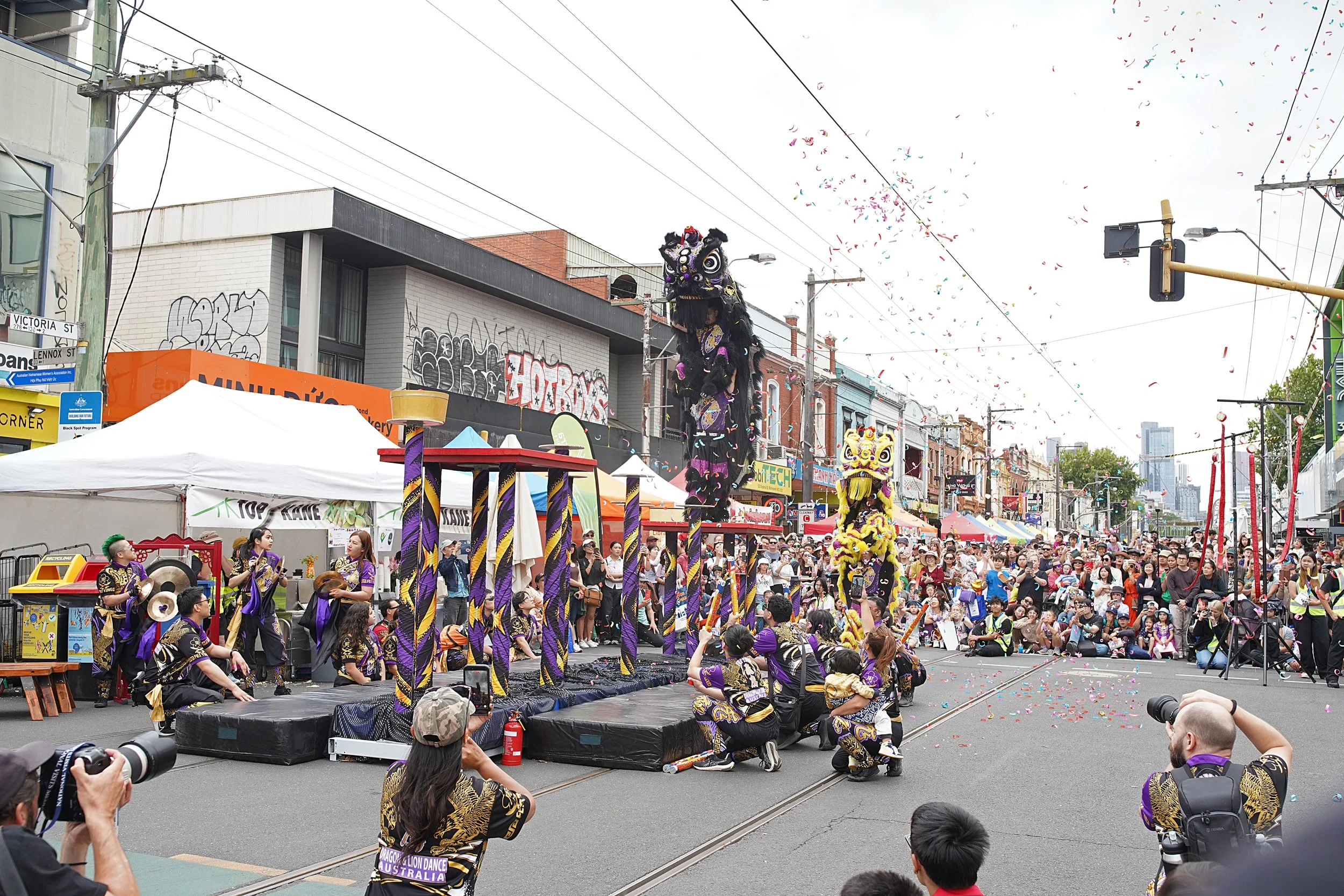
Festival and event-led activation to normalise foot traffic, including retention and growth of the Lunar Festival and smaller, trader-led collaborations
Support for culturally anchored hospitality, dining, and experiential retail
Encouragement of evening economy uses once safety thresholds were met
Vacancy activation and reuse mechanisms to prevent long-term blight
Outcomes:
Increased pedestrian dwell time
Observable growth in legitimate day and night activity
Reset perceptions of the street’s identity and role
A parallel priority has been rebranding Victoria Street as a multicultural dining and civic destination — a true street for people, not merely a traffic corridor.
Pillar 4: Leadership & Governance (Clear Ownership Across Government)
A defining difference on Victoria Street has been clear ownership and delivery capability.
Key actions:
Defined VSBA and Council leadership roles, aligned with State agencies, to coordinate delivery
Whole-of-government accountability focused on outcomes rather than announcements
Proposal for a dedicated place-based delivery body (VSBA or similar)
Funding ask:
$200,000 per year for four years to coordinate activation, trader support, and cross-agency delivery
Outcomes:
Reduced duplication
Closed enforcement and delivery gaps
Sustained momentum beyond initial interventions
What Victoria Street Proves
Victoria Street confirms that:
Strip decline is structural, not cultural
Safety is the gateway condition for economic recovery
Investment must be visible, place-based, and coordinated
Leadership must be explicit, funded, and continuous
Most importantly, it proves that recovery is achievable within existing urban fabric when State and Council settings align.
Implications for Other Strips
The Victoria Street model is directly applicable to:
Bridge Road
Sydney Road
Chapel Street
Glenferrie Road
Each requires local tailoring, but the sequence does not change:
Safety first (State-led)
Visible investment (State settings, Council delivery)
Demand activation (Council-led)
Clear leadership (shared accountability)
Strategic Positioning
Victoria Street should now be recognised as:
A State-backed demonstration corridor
A reference case for inner-Melbourne strip revival
Proof that coordinated State–Council intervention delivers faster and more durable returns than fragmented programs
The next step is deliberate scaling — before further decline hardens elsewhere.